Acupressure for Orthopedic Problems
What counts as an orthopedic problem?
An orthopedic problem is anything affecting our limbs, joints, or muscles where we feel pain or find our movement restricted. It usually shows up as an issue in the musculoskeletal system — a stiff shoulder, an aching knee, a back that won't loosen — though it often reflects something originating elsewhere in the body.
How we approach these conditions
For musculoskeletal complaints we draw on a few complementary approaches: acupressure, movement lessons, and hands-on manual therapy. They overlap and support one another, and which we lean on depends on you and on what your body is asking for.
How acupressure helps
We don't yet have a complete, textbook explanation in Western scientific terms for why acupressure works as well as it does — but we do understand some of its effects. Applied to specific points, sustained pressure works directly on the muscles, on the nervous system, and through our hormonal system. Working gently with these points helps align and regulate how other systems function too.
Here are the main ways acupressure helps with orthopedic issues.
Meridian therapy
The meridians carry other, more subtle qualities, but they also run along lines that roughly follow the muscular and biomechanical structure of the body. By stimulating points along them, we can ease the unhelpful build-ups and deficiencies that gather along these lines — balancing tissue that's overcharged and tight against tissue that's weak or underused, to relieve pain or support a muscle that has wasted.
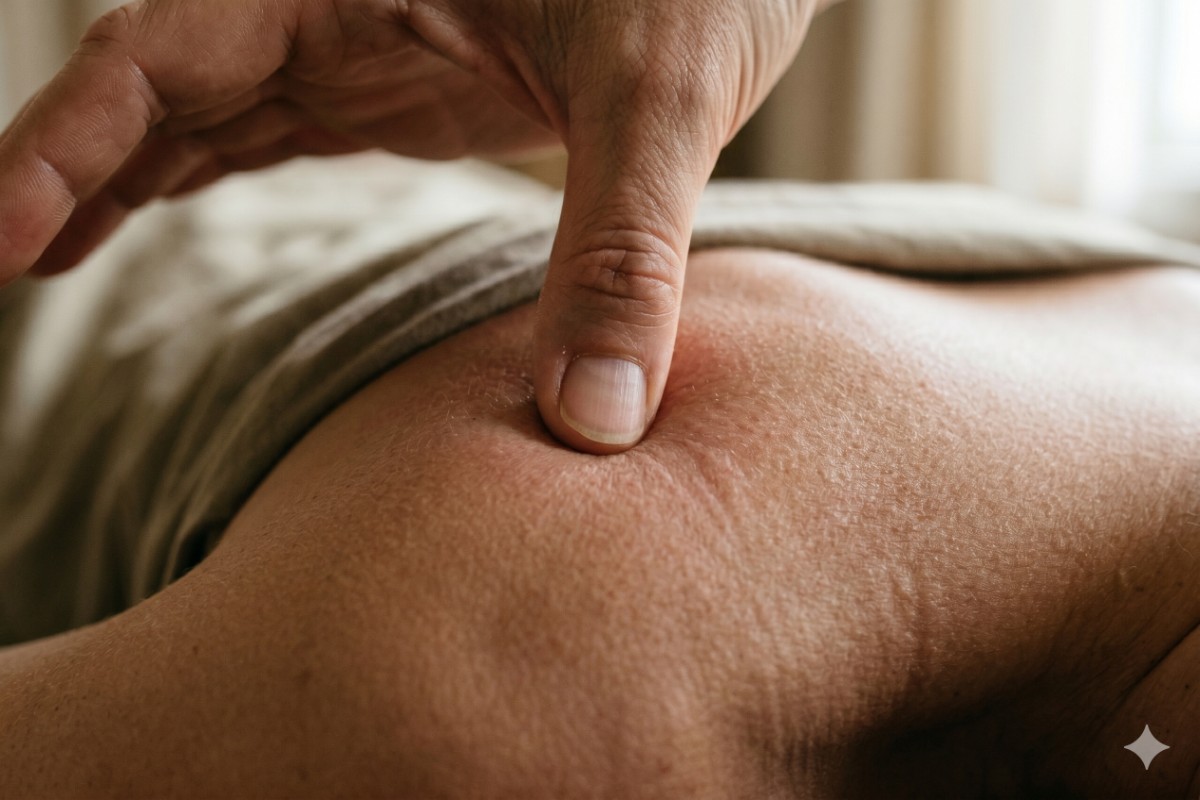
With steady thumb or finger pressure we can release taut muscles, wake up muscles that have gone quiet, and even gently fine-tune posture.
One surprising feature of meridian therapy: because some meridians are very long — a few run all the way from the head to the toes — we can often press a point far from where it hurts and still ease the pain. In Shiatsu, for instance, the intention is often to soften a tender spot indirectly first, by working systemic and meridian points, before approaching it directly.
Systemic treatment
Some of our local aches are really the local expression of something broader. Treating that wider pattern often clears not only the specific pain but a whole cluster of other complaints — some we'd never have guessed were connected.
A familiar example is pain that grows out of unresolved stress. Among many other things, stress leads the body to hold its muscles so tightly that they ache and can no longer lengthen the way they're meant to. We could simply work the tight muscle — but if we can ease the source of the tension, or the way the body habitually responds to it, the results tend to last, because we've resolved something deeper that might otherwise have resurfaced elsewhere, as a different problem.
Taking care of these systemic patterns also makes the local points more effective, by improving the flow through the meridians. In Shiatsu, a session often begins with exactly this kind of groundwork — a base treatment — and only turns to the local pain afterwards, if it hasn't already eased.
In short
Acupressure offers a gentle, hands-on way to work with orthopedic pain — meeting it both where it hurts and at its source. When a stiff or painful area has been with you for a while, it's often a sign that the body is asking for attention on more than one level.
If you'd like to explore an acupressure-based approach to a stubborn ache, you're welcome to get in touch.
Subscribe to our newsletter
Get gentle reflections, wellness insights, and breathing practices straight to your inbox.